
Short answer: for rust removal, paint stripping and weld preparation, laser cleaning beats sandblasting on almost every count. It needs no abrasive media and no chemicals, leaves no grit to clean up, works only where you point it and doesn’t wear away the base metal. Sandblasting still makes sense for blasting very large areas when you need a rough surface profile for coatings.
The quick verdict
Best for most shops
Laser cleaning
Clean, precise and media-free. Ideal for rust, paint and weld preparation.
Sandblasting
Fast on large areas, but messy, abrasive and full of media to buy, contain and dispose of.
Grinding and chemicals
Slow, labor-intensive and hard on both the part and the operator.
How does laser cleaning work?
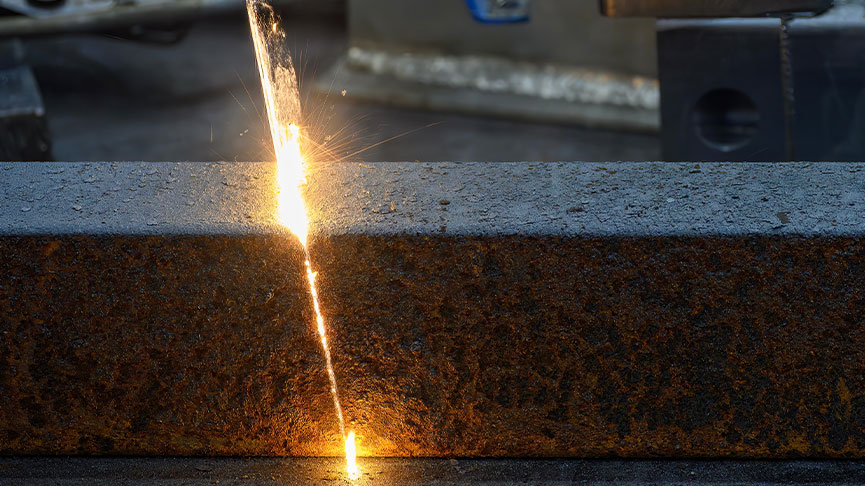
A laser cleaning machine scans a pulsed fiber laser beam across the surface. Rust, paint, oil and oxide layers absorb the energy and are vaporized or lifted off, while the clean metal underneath reflects most of it and stays intact. The operator holds a handheld cleaning head and moves it over the part, much like using a spray gun, and sets the parameters on a touchscreen.
Sandblasting works the opposite way: it fires abrasive media at high speed to knock contaminants off. That media also hits the base metal, spreads dust everywhere and has to be collected and disposed of after every job.
Laser cleaning vs sandblasting: side-by-side comparison
| Criteria | Laser cleaning | Sandblasting |
|---|---|---|
| Consumables | None: no media, no chemicals | Abrasive media to buy, store and replace |
| Cleanup and waste | Minimal: removed material is extracted as fumes | Spent media and dust to collect and dispose of |
| Effect on base metal | Non-contact, no wear on the part | Abrades and changes the surface |
| Precision | Cleans only where you aim, no masking needed | Hard to control near edges, threads and sensitive areas |
| Setup | Plug in and start, portable unit | Blast booth or containment, compressor and media handling |
| Operator conditions | No flying grit; needs laser safety and fume extraction | Dust, noise and rebound media |
| Best for | Rust, paint, weld prep, maintenance and localized cleaning | Very large areas that need a rough coating profile |
What can a handheld laser cleaner remove?
Our handheld laser cleaning machines come in 1,500 W, 2,000 W and 3,000 W. These are the reference values for each type of coating:
| What you remove | Cleaning depth | Cleaning speed |
|---|---|---|
| Light surface rust | 20 µm | 50 mm/s (about 2 in/s) |
| Paint | 100 µm | 50 mm/s (about 2 in/s) |
| Heavy rust | 120 µm | 50 mm/s (about 2 in/s) |
The SUP22C cleaning head sweeps a line up to 300 mm (about 12 in) wide, and the machine is set from a 7 in touchscreen. No expert knowledge is needed to operate it.
Laser cleaning for weld preparation
Rust, mill scale, paint and oil in the joint are a common cause of porosity and weak welds. Laser cleaning removes them right before welding, exactly along the joint, without grinding the edges or leaving grit behind. It is especially useful with handheld laser welding, where clean joints make the biggest difference, and our 3-in-1 laser machines weld, cut and clean with the same unit.
Where laser cleaning pays off
- Weld preparation of joints and edges on steel, stainless and aluminum.
- Rust removal on parts, structures and stored material before processing.
- Paint and coating stripping for repairs and rework.
- Maintenance cleaning of molds, tooling and machine parts, without disassembly or media getting into mechanisms.
- Post-weld cleaning of discoloration and oxides.
Where does sandblasting still fit?
If you blast very large surfaces every day and your coating system requires a rough anchor profile, a blast room is still a practical tool. For everything else in the shop, from weld prep to rust and paint removal, a handheld laser cleaner is cleaner, more precise and much easier to run.
How to choose a laser cleaning machine
- Power. 1,500 W for lighter, localized work; 2,000 W or 3,000 W to clean more area per hour and handle heavy rust and thick paint.
- Cleaning only or 3-in-1. A dedicated cleaner for maintenance and surface prep, or a 3-in-1 machine if you also need laser welding and cutting.
- Controls. Look for password access, real-time monitoring and remote assistance.
- Safety setup. Handheld fiber lasers are Class 4: plan a controlled area, laser-rated eyewear, fume extraction and operator training.
- Local support. Training and service from a U.S. team.
500+ machines installed across the Americas. Our U.S. team in Centre, Alabama trains your operators on laser cleaning and welding.
Frequently asked questions
Is laser cleaning better than sandblasting?
For most shop work, yes. It needs no media or chemicals, leaves no grit, doesn’t wear the base metal and cleans only where you aim.
Does laser cleaning damage the metal?
With the right settings, no. The coating absorbs the laser energy, while the clean metal underneath reflects most of it.
Can a laser remove paint as well as rust?
Yes. Our handheld laser cleaners remove light rust, heavy rust and paint, with reference cleaning depths of about 20, 120 and 100 µm respectively.
Is laser cleaning safe?
Yes, with the right setup: a controlled work area, laser-rated eyewear, fume extraction and trained operators.
Can one machine weld and clean?
Yes. Our 3-in-1 handheld laser machines weld, cut and clean, so you can prepare a joint and weld it with the same unit.

Pedro Molinari leads Patagonia CNC Machines in the United States from Centre, Alabama, helping fabrication shops choose and run laser cutting, laser welding and bending equipment.