
Short answer: for most sheet metal work, handheld fiber laser welding beats both MIG and TIG. It welds several times faster than TIG, puts far less heat into the part and leaves a clean bead that needs little or no grinding. That is why more fabrication shops are moving their sheet metal production to laser. MIG still has a place for heavy structural steel thicker than about 3/16 in (5 mm).
The quick verdict
Best for sheet metal
Handheld laser
Fastest, cleanest and easiest to learn. Plus cutting and cleaning in the same machine.
MIG
Still useful for heavy structural steel, but spatter means extra grinding on every part.
TIG
Clean welds, but slow and dependent on skilled welders who are hard to find.
How does handheld laser welding work?
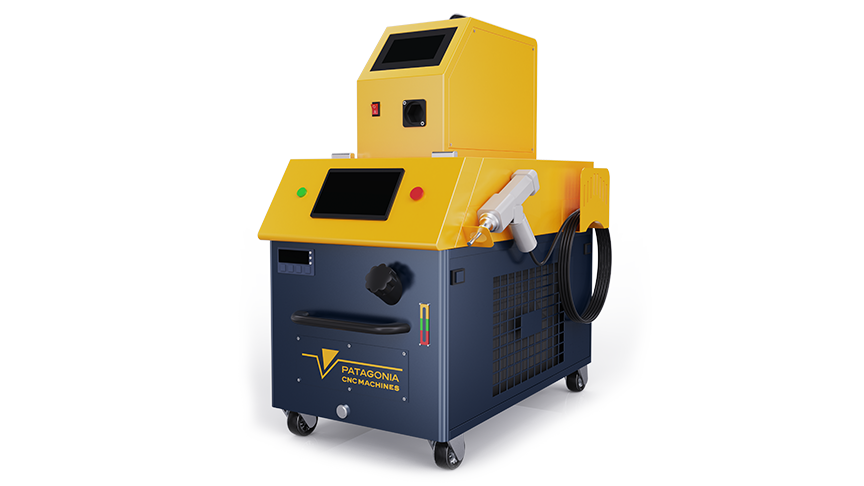
A handheld fiber laser welder sends a high-energy laser beam through a fiber optic cable to a welding gun. The beam is focused into a very small spot, so it melts the joint in a narrow, deep weld pool instead of heating a wide area the way an arc does. Shielding gas protects the weld, and an integrated wire feeder adds filler metal when the joint needs it.
Because the energy is so concentrated, the metal around the joint stays much cooler. In practice, that means thin parts don’t warp, there is almost no spatter, and stainless steel shows far less heat discoloration. The operator guides the gun by hand, just like a MIG torch, and picks the welding program on a touchscreen.
Laser vs MIG vs TIG: side-by-side comparison
| Criteria | Handheld fiber laser | MIG | TIG |
|---|---|---|---|
| Travel speed | Fast: up to 120 mm/s (about 4.7 in/s) | Fast, but finishing adds time | Slow |
| Heat distortion | Very low | Medium to high | Medium to high |
| Finish and cleanup | Clean bead, little or no grinding | Spatter, grinding usually needed | Clean, but slow to produce |
| Learning curve | Short | Moderate | Long, needs skilled welders |
| Consumables | Shielding gas, optional wire | Wire, gas, contact tips | Tungsten, gas, filler rod |
| Extra functions | Laser cutting and cleaning (3-in-1) | Welding only | Welding only |
| Best for | Sheet metal up to 3/16 in (5 mm) | Heavy structural steel | Specialty welds |
Where laser welding really pays off: the hours after the weld
Arc speed is only part of the story. On most sheet metal jobs, a big share of the labor happens after the weld: grinding spatter, polishing the bead, straightening warped panels and redoing parts that came out of tolerance. Laser welding attacks exactly those hours.
- Less grinding and polishing. With almost no spatter and a narrow bead, many parts go straight to the next step.
- Less straightening. Low heat input keeps thin panels, doors and enclosures flat.
- Less dependence on hard-to-hire welders. New operators become productive much faster than with TIG.
- One machine, three jobs. The same 3-in-1 unit also cuts and removes rust or paint before welding.
What thickness can a handheld laser welder handle?
Thickness depends on laser power and material. These are the reference ranges for our 3-in-1 handheld laser welders:
| Laser power | Stainless steel | Carbon steel | Galvanized | Aluminum |
|---|---|---|---|---|
| 1,500 W | 0.5–3.0 mm (0.02–0.12 in) | 0.5–3.0 mm (0.02–0.12 in) | 0.5–2.5 mm (0.02–0.10 in) | 0.3–1.8 mm (0.01–0.07 in) |
| 2,000 W | 0.5–3.5 mm (0.02–0.14 in) | 0.5–3.5 mm (0.02–0.14 in) | 0.5–3.0 mm (0.02–0.12 in) | 0.3–2.3 mm (0.01–0.09 in) |
| 3,000 W | 0.5–5.0 mm (0.02–0.20 in) | 0.5–5.0 mm (0.02–0.20 in) | 0.5–4.5 mm (0.02–0.18 in) | 0.3–3.5 mm (0.01–0.14 in) |
Aluminum needs more power than steel for the same thickness because it reflects more laser energy and spreads heat faster. If you weld a lot of aluminum, size the machine for your thickest aluminum part.
Which jobs should move to laser first?
- Enclosures, cabinets and panels, where flatness and appearance matter.
- Stainless steel equipment such as food service and kitchen equipment, where clean welds save polishing time.
- Furniture, frames and brackets in thin steel or aluminum.
- Galvanized sheet, where low heat input helps protect the coating around the weld.
- Signage and architectural metalwork, where the weld is part of the finished look.
Where does MIG still fit?
Keep your MIG for heavy structural steel above 3/16 in (5 mm), multi-pass welds and field repairs. For the rest of your sheet metal work, a handheld laser welder does the job faster, cleaner and with less finishing. Most shops that switch keep one MIG for heavy parts and move everything else to laser.
How to choose the right handheld laser welder
- Laser power. Choose 1,500, 2,000 or 3,000 W based on your thickest regular part and main material.
- Cooling. Water-cooled units handle heavier duty cycles. Compact air-cooled units are lighter and easy to move around the shop.
- Integrated wire feeder. Set from the same touchscreen, it bridges gaps of up to 0.5 mm (0.02 in) and adds reinforcement where needed.
- 3-in-1 capability. Welding, cutting and cleaning in one machine gets more use out of a single investment.
- Local training and support. Make sure someone in the U.S. trains your operators and answers the phone when you need help.
- Safety setup. Handheld fiber lasers are Class 4. Plan a controlled welding area, laser-rated eyewear and operator training, following ANSI Z136.1.
500+ fiber laser cutting machines installed. The same team that supports them trains your operators on laser welding, from our U.S. base in Centre, Alabama.
Frequently asked questions
Can a handheld laser welder replace MIG welding?
For sheet metal up to 3/16 in (5 mm), yes, and most shops that switch also cut their grinding time. Keep MIG for heavy structural work.
Is a laser weld as strong as a MIG or TIG weld?
With proper settings and fit-up, a laser weld achieves full penetration on sheet metal with a much narrower heat-affected zone, so the base metal around the joint keeps more of its original properties.
What metals can a handheld fiber laser weld?
Stainless steel, carbon steel, galvanized sheet, aluminum and copper.
Does laser welding need shielding gas?
Yes. It typically uses argon or nitrogen, depending on the material and the finish you need.
How long does it take to train an operator?
Much less than TIG. Welding programs are stored in the machine and selected on a touchscreen, so operators focus on technique instead of tuning settings. Our U.S. team provides operator training and technical support with every machine.

Pedro Molinari leads Patagonia CNC Machines in the United States from Centre, Alabama, helping fabrication shops choose and run laser cutting, laser welding and bending equipment.