
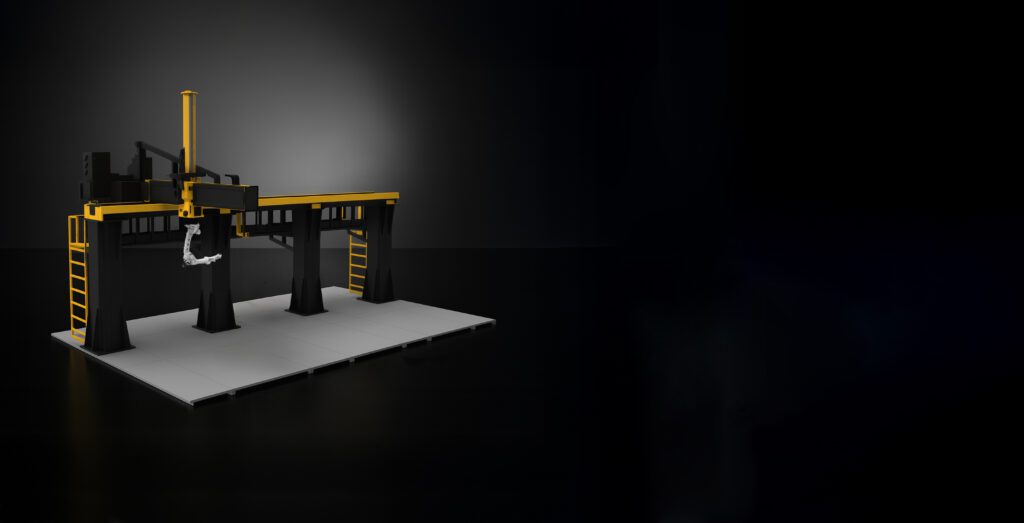
Short answer: large parts like structural beams, columns, trailer chassis and modular frames are too big for a standard welding cell. Mounting the welding robot on a gantry or a linear track extends its reach to the whole part, and new AI welding software lets the robot find and weld each joint without being programmed. The result: long, heavy structures welded automatically, with consistent quality and an operator trained in about two hours.
The quick verdict
Manual welding
Slow on long welds, hard to staff and heavily dependent on crane handling and skilled welders.
Best for large parts
Gantry or track robot + AI software
Full reach over the part, no robot programming and no dedicated fixtures.
Camera-based robot
Automated, but needs programming, prepared surroundings and fixtures for each part.
Why large parts need a different kind of automation
A standard robotic welding cell is built around a table a few feet long. Beams, columns, trailer frames and modular structures can be 20 ft long or more, weigh several tons and have welds on every side. Welding them by hand means long hours under the crane, constant repositioning and results that depend on who is welding that day. To automate them, the robot has to come to the part, not the other way around.
Three ways to extend a welding robot’s reach
- Robot on a gantry with 3 axes of travel. The 6-axis robot is mounted on a gantry that adds long horizontal travel (Y axis), short cross travel (X axis) and vertical motion (Z axis), so it can reach any point of a large part.
- Inverted robots on a gantry with rotary tables. Robots hang upside down from the gantry and work with rotary tables, rotators and positioners, giving the torch access to every side of the part.
- Robot on a linear track. The robot travels along a floor track, extending its work area along long parts such as beams and frames.
Welding large structures without programming the robot
Programming every joint of every beam used to be the biggest obstacle to automating structural welding. Our Pro systems remove it with Perfect ARC, an AI-powered welding software, combined with Panasonic welding robots made in Japan:
- No robot programming. The software generates the welding automatically.
- Touch sensing. The robot finds the position of each joint by touch, with no camera and no laser scanner.
- Arc sensing. While welding, it measures the groove width and centers the torch to compensate for misalignment.
- No dedicated fixtures and no special hardware, just an internet connection.
- About 2 hours of training for the operator.
How it compares with manual welding and camera-based robots
| Criteria | Patagonia Pro systems | Manual welding | Camera-based robot |
|---|---|---|---|
| Programming time | None | N/A | High |
| Preparing the work area | Not required | Required | Required |
| Operator skill level | Low | High | Very high |
| Dedicated fixtures | Not required | Not required | Required |
| Efficiency lost to sensing | Low | N/A | High |
Which parts can you automate?
| System | Parts | Configurations |
|---|---|---|
| BeamPro | Structural profiles: H and W beams, HSS columns, channels and fabricated beams, with stiffeners and connectors welded in one operation | Single station + 1 robot, double station + 1 robot, double station + 2 robots |
| ModulPro | Modular metal structures | Variable length, multiple robots, optional positioner |
| FramePro | Trailers, chassis and dump bodies | Adapted to each frame design |
| Custom gantry projects | Any large part that needs extra reach | Gantry, inverted robots, linear track, rotary tables and positioners |
How to choose the right system for your parts
- Part size and weight. Length, width and weight decide between a linear track, a gantry or a combination with positioners.
- Part families. Standard profiles fit a BeamPro, while modular frames and trailers have their own systems.
- Volume. Double-station and two-robot configurations keep welding while the next part is loaded.
- Floor space and handling. Plan crane access, loading areas and part flow from cutting to welding.
- Engineering support. Our team handles every stage: engineering, 3D design, virtual analysis, manufacturing, robotic integration, installation and commissioning.
For smaller, repeat parts, a standard cell may be enough. See Is a Robotic Welding Cell Worth It?
500+ machines installed across the Americas, and a dedicated team for every project stage, from 3D design to commissioning.
Frequently asked questions
What is a gantry welding robot?
It is a welding robot mounted on a gantry that moves it over the part along several axes, so it can weld large parts that would not fit in a standard robotic cell.
Do I need to program the robot for each beam?
Not with our Pro systems. The Perfect ARC software generates the welding automatically, and touch and arc sensors locate and follow each joint.
What parts can be welded automatically?
H and W beams, HSS columns, channels and fabricated beams, modular structures, trailers, chassis and dump bodies, plus custom large parts.
How long does it take to train an operator?
About two hours, because the operator does not need to program the robot.
Gantry system or standard robotic cell?
Choose a standard cell for small and medium repeat parts. Choose a gantry or track system when parts are long, heavy or need welds on several sides.
Pedro Molinari leads Patagonia CNC Machines in the United States from Centre, Alabama, helping fabrication shops choose and run laser cutting, laser welding and bending equipment.