

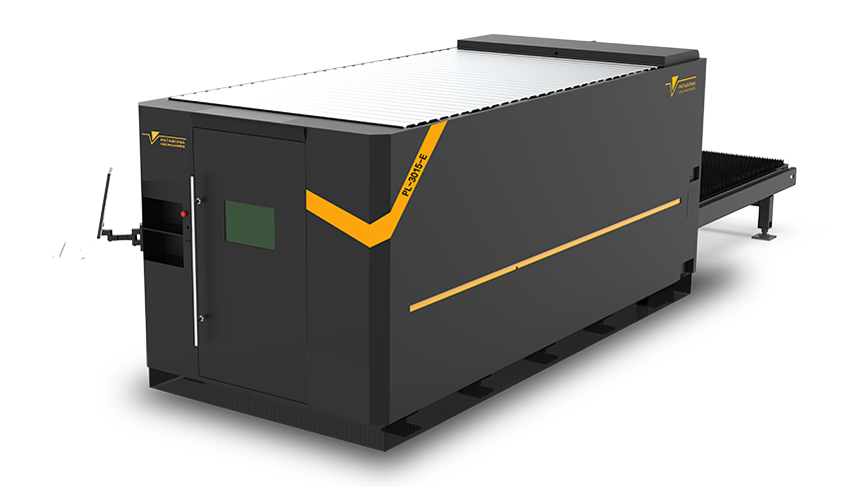
Short answer: for most fabrication work, a fiber laser beats plasma on every cut that matters. It holds tighter tolerances, cuts small holes and fine details plasma can’t, and leaves clean, square edges that go straight to bending or welding without grinding. Today’s high-power fiber lasers also cut carbon steel several inches thick, which takes away plasma’s last big advantage. Plasma still has a place for portable field work.
The quick verdict
Best for most shops
Fiber laser
Precise, clean, fast and easy to automate, from thin sheet to thick plate and tube.
Plasma
Portable and simple, but rough, tapered edges mean extra work on almost every part.
Laser + oxy-fuel hybrid
For very thick plate: one machine that switches to oxy-fuel for cuts up to about 8 in.
How do fiber laser and plasma cutting work?
A fiber laser focuses a high-power laser beam into a spot a fraction of a millimeter wide. The beam melts the metal and an assist gas (oxygen, nitrogen or compressed air) blows it out of the cut. Because the beam is so narrow and so precisely controlled by the CNC, the result is a thin kerf, sharp corners and square edges.
A plasma cutter forces gas through a small nozzle and turns it into an electric arc hot enough to melt metal. The arc is much wider than a laser beam and harder to control, so the cut is wider, the edges come out beveled and rough, and a ridge of re-solidified metal (dross) usually sticks to the bottom of the part.
Fiber laser vs plasma: side-by-side comparison
| Criteria | Fiber laser | Plasma |
|---|---|---|
| Precision | Very high: ±0.0019 in (0.05 mm) positioning accuracy | Moderate |
| Edge quality | Clean, square edges, ready for bending or welding | Beveled edges with dross, usually need grinding |
| Small holes and fine details | Yes, clean small holes, slots and sharp corners | Limited, holes come out tapered |
| Heat-affected zone | Narrow | Wide |
| Speed on sheet metal | Very fast | Fast, but finishing adds time |
| Thick plate | Up to about 4 in (100 mm) with high-power sources | Its traditional strength |
| Tubes and profiles | Dedicated tube lasers with 0–45° bevel option | Possible, with lower precision |
| Automation | Shuttle tables, automatic loading and unloading, nesting software | Limited |
How thick can a fiber laser cut today?
Thick plate used to be plasma territory. Not anymore. Fiber laser power has grown fast, and our machines are available from 1.5 kW up to 120 kW. This is how thick each power can cut carbon steel:
| Laser power | Carbon steel, maximum thickness |
|---|---|
| 3 kW | 3/4 in (19 mm) |
| 6 kW | 0.83 in (21 mm) |
| 12 kW | 1 1/2 in (38 mm) |
| 20 kW | 2 in (50 mm) |
| 40 kW | 2 1/2 in (65 mm) |
| 60 / 120 kW | Up to about 4 in (100 mm) |
| Laser + oxy-fuel hybrid | Up to about 8 in (200 mm) |
For plate thicker than that, our hybrid system combines a fiber laser head with oxy-fuel cutting in one machine. It switches between modes quickly and handles plate up to about 8 in (200 mm), so even heavy plate no longer requires a plasma table.
The hidden cost of plasma: everything that happens after the cut
Comparing cutting speed alone misses most of the story. With plasma, a large share of the labor happens after the part leaves the table:
- Grinding dross off the bottom edge of almost every part.
- Drilling or reaming holes that plasma can’t cut accurately.
- Fixing fit-up in welding, because beveled edges and loose tolerances don’t line up.
- Problems at the press brake, where inconsistent edges throw off bend accuracy.
A fiber laser removes most of those steps. Parts come off the table ready for the next operation, which shortens lead times and frees your people for work that adds value.
Which jobs should move to fiber laser first?
- Sheet metal parts with holes, slots and tabs, such as brackets, enclosures and panels.
- Stainless steel and aluminum, where nitrogen cutting leaves bright, oxide-free edges.
- Parts that go to the press brake or welding cell, where accuracy saves time downstream.
- Tubes, pipes and structural profiles, cut and beveled on a dedicated tube laser.
- High-volume production, where shuttle tables and automatic loading keep the machine cutting.
Where does plasma still fit?
Plasma remains useful for portable work on the job site, demolition and repairs where you need to take the cutter to the part. Inside the shop, a fiber laser covers sheet, plate and tube with far better quality, and a laser + oxy-fuel hybrid takes care of very thick plate.
How to choose the right fiber laser cutting machine
- Laser power. Size it for your thickest regular material, not your occasional job. Our range goes from 1.5 kW to 120 kW.
- Working area. Match the bed to your sheet size, from 5 × 10 ft (3050 × 1530 mm) up to formats over 40 ft long.
- Enclosed or open. Enclosed machines with a shuttle table maximize safety and output. Open machines give easy access and a smaller footprint.
- Sheet, tube or both. Dedicated tube lasers cut pipes, tubes and H-beams. Combined models cut plate and tube in one system.
- Automation. Automatic table changeover (15 seconds on our enclosed models), loading and unloading systems and nesting software multiply productivity.
- Support. Look for spare parts and consumables in stock, remote diagnostics and operator training from a local team.
500+ fiber laser cutting machines installed across the Americas, supported in the U.S. from our base in Centre, Alabama.
Frequently asked questions
Is fiber laser better than plasma cutting?
For most shop work, yes. A fiber laser is more precise, produces cleaner edges and cuts small holes and details plasma can’t, so parts need little or no finishing.
Can a fiber laser cut thick plate?
Yes. With high-power sources, fiber lasers cut carbon steel up to about 4 in (100 mm), and a laser + oxy-fuel hybrid goes up to about 8 in (200 mm).
Can a fiber laser cut stainless steel and aluminum?
Yes. Fiber lasers cut carbon steel, stainless steel and aluminum. With nitrogen as assist gas, stainless and aluminum come out with bright, oxide-free edges.
Can a fiber laser cut tubes and beams?
Yes. Dedicated tube lasers cut round, square and rectangular tubes, pipes and H-beams, with an optional bevel head for 0–45° cuts.
Is a fiber laser hard to operate?
No. The control software is intuitive and handles nesting and cutting parameters. Our U.S. team trains your operators and supports them remotely when they need help.

Pedro Molinari leads Patagonia CNC Machines in the United States from Centre, Alabama, helping fabrication shops choose and run laser cutting, laser welding and bending equipment.